Sections: Information | Illustration | Article Text
Information
- Published: February 1983 issue of The Twilight Zone Magazine
Illustration
-
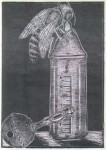
- Engraved Illustration from “Royal Jelly”
Article Text
Introduction:
Dahl’s house …
Here’s an unusual glimpse into the literary life. It’s ROALD DAHL, writing in the February ’81 Architectural Digest:
“I had become an enthusiastic collector of pictures as soon as World War II ended, in 1945. Each time I sold a short story I would buy a picture. Then, because it took me so long to write another story, I would invariably have to sell the picture I had bought six months before. In those days fine pictures were inexpensive. Many paintings that today could be acquired only by millionaires decorated my walls for brief periods in the late 1940s: Matisses, enormous Fauve Rouaults, Soutines, Cézanne watercolors, Bonnards, Boudins, a Renoir, a Sisley, a Degas seascape …
“My love of eighteenth-century English furniture is second only to my love of paintings. I don’t admire anyone who buys fine furniture–or fine anything, come to that–without troubling to study the history of the artists involved. How many people who buy superb furniture of this period have a copy of Chippendale’s great book, The Gentleman and Cabinet-Maker’s Director? Or similar works by Hepplewhite and Sheraton? You cannot begin to appreciate any work of art in the true sense until you have studied the personalities involved and the struggles they had. Equally, I don’t admire those who buy only for investment. My pictures, which I suppose are now rather valuable, are not insured. If the house burns down, then that’s just bad luck. I would miss my pictures, but money would be no compensation. I’ll be damned if I’ll insure them, or anything else, except my life. I will insure my life, because there is no way at all in which I can profit from it myself.”
It’s interesting to see how cleverly Dahl makes use of his hobbies in his fiction: “Skin” is set in the art world (it concerns a man with a masterpiece tattooed on his back), “Parson’s Pleasure” is about a collector of eighteenth-century furniture, and “Taste” is about a wine-tasting contest (Dahl’s home boasts a 3000-bottle wine cellar). You’ll get a somewhat longer look at this demanding, rather fatalistic fellow in the interview beginning on page 70. It was conducted in England by LISA TUTTLE, whose “A Friend in Need” (TZ August ’81) has just been included in The Year’s Best Fantasy Stories from DAW, and whose novel Familiar Spirit is due this spring from Berkley. She says, in a letter, “Dahl was really nice and rather funny (which I hope comes across in the interview).” I think you’ll agree that it does.
Roald Dahl: HIS STYLE IS WITTY, HIS IMAGINATION’S NASTY … AND HE ALSO WRITES FOR CHILDREN.
‘It’s got to be bloody good!
Interviewer Lisa Tuttle reports:
A man from the south who wants to bet a shiny new car against one of your own fingers; the murder weapon eaten by obliging police; the beekeeper obsessed with royal jelly–the images linger. Roald Dahl’s unique, macabre and horrifically funny stories are classics of the form.
Roald Dahl was born in Wales of Norwegian parents in 1916, and educated in England. His early career included a part in an expedition to explore the interior of Newfoundland and work with the Shell Oil Company in London and Dar-es-Salaam. At the outbreak of World War II, he joined the Royal Air Force and was shot down over the Libyan Desert. After further action over Greece and Syria, injuries made it impossible for Dahl to continue flying, and he was posted to Washington, D.C., as assistant air attache.
Shortly after Dahl arrived in Washington, the writer C. S. Forester asked to interview him about his combat experiences for the Saturday Evening Post. Trying to describe his “most exciting experIence,” Dahl found himself getting bogged down in details, and suggested that he would write it all down and send it to Forester to use in writing the story. A week later, Dahl was astonished to receive a check for a thousand dollars and the news that the Post would use his story exactly as he had written it, and wanted more.
Not quite believing the ease with which he’d made so much money, Dahl began to write more flying stories. When he had exhausted his own experiences, he made them up. They all sold to top American magazines and were subsequently collected into a book called Over to You (1946).
After the war Dahl continued to write, producing the short stories that were later collected as Someone Like You (1953) and Kiss Kiss(1959). Now acclaimed as a brilliant short-story writer, Dahl went on, in the 1960s, to establish himself as a screenwriter (as in the 1967 James Bond film You Only Live Twice) and as a master of another difficult field: children’s literature. Among his best-selling children’s books are James and the Giant Peach; Danny, Champion of the World; The Twits; and–recently voted the most popular children’s book of all time in a poll conducted by the London Sunday Times–Charlie and the Chocolate Factory.
In 1952 Roald Dahl married actress Patricia Neal. They have three daughters and one son and, at the time of this interview, were living in England, in a picturesque Buckinghamshire village. Their house might be the setting for one of Dahl’s stories: it’s the house of a connoisseur, a collector of fine art, antique furniture, and oddities. A glass cage in the kitchen shelters a couple of sluggishly climbing tree crabs. There’s a wine cellar below, holding three thousand bottles, and outside in the garden a hothouse turns the English spring into a tropical summer for the benefit of the exotic orchids grown there.
Every morning Dahl walks across the garden (with the aid of a cane, as both his hip joints are artificial) to a small brick hut. In stark contrast to his well-kept, comfortable house, this hut is barely furnished with filing cobinets, a table, and a disreputable-looking old armchair. The windows are thickly grimed, the floor is dirty cement, and there seems to be a thin layer of grit covering everything. Dahl obviously takes pride in the fact that his tiny sanctum hasn’t been cleaned in years, if ever.
There, in the large armchair–sometimes wrapped in a blanket against the chill and with a thermos of coffee close at hand–Roald Dahl sits with a pad of paper and a box of Ticonderoga pencils imported from the U.S., and writes, very slowly, with much thinking and erasing, until lunchtime.
TZ: You’re very famous as a children’s writer these days, but I want to talk to you about your short stories.
Dahl: Ah, good. We will. They were the result of, I suppose, twenty-five years of solid work, doing nothing else, and not many people have devoted themselves to that. Twenty-five years of solid work, absolutely nothing but these short stories.
TZ: I know the story of how you wrote the stories that were collected inOver to You …
Dahl: Good! Thank God I don’t have to say all that again.
TZ: But once you’d written them, you went on to write more short stories. Why? Why not a novel?
Dahl: I think I had a very strong feeling that it was my metier, you know. And if you find that you can do something, you don’t rush off and try to do something else. I think I was probably right. I’m not a novelist, and, on the whole, the pure short-story writer is not a novelist. People like Katherine Mansfield. I don’t think she ever wrote a novel. You see, the short-story writer has got to get everything so tight, so close, and so concise. It’s the opposite of a novel. The novelist can spread himself or herself. They can take a page or two to describe the fucking landscape, can’t they? You can’t do that in a short story. It’s as different as … I don’t know … the only thing you can say about it is that they’re both writing. But they’re entirely different. Quite a number of fine novelists have done fine short stories… Who? Ah, Hemingway. I don’t think Hemingway’s short stories are as great as people say, but he’s a wonderful novelist, early novelist anyway. Everyone has a go at them–Somerset Maugham, Graham Greene, everyone–but they’re all primarily novelists, aren’t they?
TZ: And short-story writers who try to write novels?
Dahl: Usually it’s a cock-up. I mean, Maupassant never wrote a novel, did he? I don’t think he did. The modern great short-story writers, to me, are John Collier–we were all of a bunch in The New Yorker in the late ’40s, you know–John Cheever, J. D. Salinger. He did one novel, Catcher in the Rye. Super. But just the one. He was really a supreme short-story writer, but he only had eleven good ones, then he ran out. Maupassant–have you reread Maupassant lately?
TZ: No.
Dahl: You will be disappointed. He’s got the biggest reputation of all short-story writers, and I think he’d have a job selling some of them today, I really do.
TZ: Why? Because they aren’t any good, or because so many other people have done the same things since?
Dahl: Standards go up all the time. I don’t think standards go up in, say, painting–no one has ever painted better than Van Gogh or Cezanne, they paint differently. But funnily enough, writing dates unless it’s very, very good. Tolstoy doesn’t date, or Dickens, but it’s got to be bloody good. I don’t think Maupassant’s that good. I think Salinger, in his prime, was wonderful. I think John Collier–well, a quarter of his are wonderful. The trouble with most short-story writers is that they are uneven, and they bash them out too fast. I don’t know how many short-story writers you know …
TZ: A lot.
Dahl: You know a lot, do you? Good. There’s Frank O’Connor, for instance–ah, you don’t know him. Well, he was one of The New Yorker writers at that time, and there’s a mass of work by him, but the unevenness is unbelievable. I mean, there’s half a dozen good ones in a volume that big of his collected works of maybe a hundred. That doesn’t suit me at all. I will not–I try, anyway–not to do one unless it’s equal in quality to the others. That’s why I took six months for each story, so I did about two a year.
TZ: But a lot of the people who bash out short stories do it because they have to make a living. And that’s also why a lot of short-story writers write novels.
Dahl: That’s right. That’s absolutely right.
TZ: But you managed.
Dahl: It’s all about making a living. I was a bachelor then, and as I was lucky enough to sell my stories every time to the top-paying magazine in New York then, which was The New Yorker … Imagine, in 1949, getting three thousand dollars for a story. It then sold in fifteen other countries, and that added up, not nearly as much, mind you, but it added up. And then they went into a book, and that sold in fifteen countries, and you’ve got a living. For a bachelor. It’s a bit different if you’ve got three or four kids … then the pressure comes on. But I was lucky enough to marry a woman who’s also earning a living, so I just went on writing my stories. I was dedicated.
TZ: Who are the writers you feel have influenced you the most?
Dahl: D. H. Lawrence, for some of his sentences and phrasing, not for his construction–his use of words. And Hemingway, for his construction. The master, really, of modem writing. It seems to me that the universities, especially in America, make the trends, deciding whether somebody is in or out of favor. Hemingway was out of favor for a while. They’re completely wrong. He’s been a greater influence on modern writing, on English literature in this century, than anyone else who ever lived. He taught all of us the value of the short sentence, using adjectives very, very carefully–in other words, hardly at all unless you really wanted it to mean something. And you didn’t keep saying “wonderful” because it became meaningless. They’re great secrets, those, and nobody ever did it before him, they just didn’t. You can read the writers who came before him, people like Galsworthy and Bennett and even Mark Twain, although he was a very fine writer, they all threw these adjectives around. Hemingway had far greater impact. A page of Hemingway at his best has more power than a page of Twain. Or a page of Dickens, come to that. Dickens just threw adjectives around like peanuts. Although he was rather marvelous, because of it.
TZ: Why did you take the direction that you did? The short stories inKiss Kiss and Someone Like You tend to be on the macabre, disturbing side. What drew you to that sort of horrific story?
Dahl: I can’t answer that question. Nobody can answer that. It’s like, on a much higher level, let’s say old Beethoven was sitting here, and you were interviewing him, and you said, “Mr. Beethoven, how did you come to think of the Fifth Symphony?” Or, “Why did you suddenly write the later quartets? What got into you?” How the hell would he know?
TZ: No, I didn’t mean that, only the type of story, after Over to You, which was so much more autobiographical, so very different in tone–
Dahl: Ah, well, Over to You is easily explainable, because that was written during the war, which was a highly emotional time. You didn’t live in it, and most of your readers won’t have lived in it, and it’s almost impossible to understand what an emotional time it was. The Americans and the British against Hitler and the Nazis were fighting for a tremendous cause, I mean saving the world, literally. And the emotions were running endlessly high. Everyone was emotional and sentimental. That was Over to You. But then the war finished, and things got back to semi-normal, and then you went into whatever direction you were going to go, and that was it.
TZ: Then why did you begin to write for children?
Dahl: Ah, that’s a whole different thing. After having done my twenty- five years of short stories, the three volumes, I think I probably ran out of. lots, and that’s the hardest thing in the world. If you write the sort of short stories I write, which are real short stories, with a beginning, a middle, and an end, instead of the modern trend, which is mood pieces. I’m judging right now a short-story competition, a very serious big one, and there’s not one single short story I’ve read so far with a plot. They’re all mood pieces. You know: I went down to the kitchen and my wife was there and she had a saucepan and we had a little row and threw the carrots out the window and the dog came in and–they’re concentrating on their writing, and not on the content. Well, the average reader doesn’t care about the writing. They want something which will keep them reading, wondering what’s going to happen next. None of these stories says what’s going to happen next. And then to finish it satisfactorily, so the reader says ha ha, I wouldn’t have guessed that, how fantastic, how fascinating, ooh, golly! That’s jolly hard.
I found about thirty-five plots, and then I probably ran out of them. I don’t know many now. I don’t know any, I don’t think. I couldn’t sit down and write a short story now–it’s very hard. And these people who are writing them now, they don’t have any plots, they don’t bloody well have them. Maupassant had them. Salinger had them. That’s why they were so sparing. Salinger found eleven.
TZ: But to turn to children’s books because you couldn’t find plots–
Dahl: Of course you’ve got to have plots there. But it was a whole new field, and the brain started going into another gear. I’d been into the adult thing for so long … and it was great fun! It still is.
TZ: Do you find much difference in the way you approach writing for adults and writing for children?
Dahl: An enormous difference. Yes. You’ve got to write for your audience. You’ve got to go into a completely new gear. One almost goes into another frame of mind, all through the day, when you’re doing a children’s book.
TZ: I thought that your one novel, My Uncle Oswald, was very like your children’s books, except that it was for adults and all about sex. If it had been for children, the subject would have been something other than sex, but the style was very similar.
Dahl: Well, it was jokey. It was a send-up. I find it hard to be serious, even in the adult ones, for too long. There are one or two serious, very serious stories, but not many.
TZ: How do you feel about the television adaptations of your stories in Tales of the Unexpected?
Dahl: Within the limits of television, and this was commercial television, it wasn’t badly done. One or two of them were especially well done; a few were cocked-up. But, you know, one comes to expect that, and ride with it.
TZ: How much did you have to do with the series?
Dahl: I had nothing to do with it. I didn’t want anything to do with it, although they would send me the scripts and I would glance over them and put a great red line around some bloomer, and then have a little fight over it. But otherwise I kept well away. I never went to the sets or anything.
TZ: You didn’t want to write any of the scripts?
Dahl: Oh, no. I could have written all of them if I’d wanted to. I didn’t want to do any of them.
TZ: But you have written film scripts before.
Dahl: I used to do it for money, yes. Because it is a lot of money. And it’s such a beastly job, that no one would ever write film scripts except for money. Or unless you wanted to defend your own property. And even then you can’t, because they get hold of it and do what they like. I did Charlie and the Chocolate Factory; I thought I was defending it, but in the end they buggered it up.
TZ: They changed your script?
Dahl: Yes. Here you have a best-selling book, an enduring book, and they bugger the film up. Well, there’s no excuse for that–it’s just bad film-making. I hate film directors. The only nice experience I had was doing a James Bond film, You Only Live Twice. I liked that. It was a nice director, and they left you alone, and they followed the script. It was lovely. Chitty Chitty Bang Bang was ghastly. Once you get a rotten director, or an egocentric director, you’re dead. But they pay a lot, so you take the money and run.
TZ: Would you do another film script?
Dahl: If my book Danny, Champion of the World is done as a film, as I think it will be pretty soon, I would ask to do that. To defend it as best I can.
TZ: You mentioned at lunch that as soon as I leave you’re going to go upstairs and read for the rest of the afternoon. What are you reading?
Dahl: At the moment I’m reading–very slowly, and I hope it will last me a year–five volumes of the diary of a country parson. Mid-eighteenth century. I love the mid-eighteenth century because that’s when all the great furniture was made. That’s for slow reading. I also love thrillers. And I’ve got Portrait of the Artist as Young Man beside the bed, which I’m dabbing into again, because when you’ve read something twenty years ago you must dab into it again because you’ll find it’s something completely different. And I love Ed McBain–I’m reading the new 87th Precinct novel. I’ve read all the classics; I’d read them all by the time I was fifteen, I should think–everything you can think of from the nineteenth century. We read voraciously at my school–had to, no television in those days, no radio. So I’ve read them all, but it’s fun to look at them again.
TZ: Do you read many short stories?
Dahl: No. I don’t like them much because they’re lousy. I’ve read all the good ones. So have you. All of them. I’ve also read every ghost story that’s ever been written. Which produces a very interesting result. Because it turns out that women, females, excel in two phases of the arts–in literature, I should say. And that’s children’s books and ghost stories. And they’re both very difficult to do; that’s why there are so few good ones. In the ghost story, they’ve got this light, fascinating touch. Ghost stories are very difficult to do; I’ve never succeeded.
TZ: Who are the ghost story writers you like?
Dahl: Oh, let me think. I’ve got them all written down. Most of them are not very famous, the women. I’m going to bring out a collection of ghost stories of my choice, and there won’t be any of the famous ones. We’re all fed up with M. R. James and F. Marion Crawford and Algernon Blackwood and the rest of them.
TZ: Who will you have instead?
Dahl: I could give you the list. Let me see … Edith Wharton wrote a very good ghost story. And there’s Rosemary Timperley, Mary Fitt, Mrs. Gaskell, E. Nesbit–she also wrote brilliantly for children. She may be the best example of a writer who wrote for adults and for children, although today it is her children’s books which are remembered. I love her short stories, myself.
TZ: I think myself that ghosts work best in short stories, rather than novels.
Dahl: Oh, yes. Couldn’t sustain it. First of all, you’re right on the edge of unbelievability; at any moment the reader’s going to say, I don’t believe this trash. The moment you see a ghost, you’ve lost it. You’ve got to suggest it. You can’t say, a white thing fluttered across the room or down the street. Then you’re dead. It needs a very delicate touch.
TZ: You said you’d never succeeded in writing a ghost story?
Dahl: Yes, I started one and couldn’t bring it off, so I turned it into something else. It was called “The Landlady.” The young man knocking at the door, and the woman opening it– I was thinking, well, this is going to be a lovely ghost story; she’ll be a ghost, really, and she’ll let him in and something’s going to happen. But I just couldn’t bring it off. So I got a new ending, and made her just a murderess. Which was fun, but it wasn’t the same; it wasn’t a ghost story.
TZ: To go back to something you said earlier, about people today writing mood pieces rather than real short stories: I think there are real, plotted short stories still being written, and you find them mostly in the genre magazines. This magazine, The Twilight Zone, which isn’t available in England, is full of real short stories, and so are the science fiction magazines.
Dahl: Ah, yes, they are, and I hate science fiction, actually. But they’ve got to have plots, you couldn’t write science fiction without plots. My advice to people writing for your magazine would be–well, we assume you can write a bit, but remember that writing is only half the battle. The plot is the other half. And then putting it right. People who can write very well, like John Updike or Virginia Woolf, think they can get away with just writing. But you’ve got to have the plots, or people won’t care.