
Sections: Information | Cover | Interview Text
Information
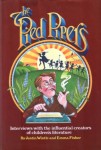
First editions:
- Paddington Press, mid-1970’s, Great Britain.
- Written by Justin Wintle and Emma Fisher
- Includes illustrations, photos, and interviews done in Q&A format
Cover
Interview Text
Interviewed by Justin Wintle
Having established a reputation as a brilliant adult short story writer in the fifties with collections like Someone Like You (1954) and the best-selling Kiss Kiss (1959), Roald Dahl spent the next decade establishing himself as a first-rank children’s writer. While many children’s authors find themselves writing for adults by default, and vice versa, his is a genuine versatility. He has turned his hand to film scripts, You Only Live Twice among them.
At its best Dahl’s writing for children is full of zany and humorous invention. Charlie and the Chocolate Factory, which has already sold over a million copies in the United States alone, is the story of a good but impoverished boy who wins the fifth and final Golden Ticket to see Willy Wonka’s Chocolate Factory. Each of his four companions is a caricature of a childish weakness: the spoilt Veruca Salt, the gum-chewing Violet Beauregarde, greedy Augustus Gloop, and Mike Teavee; and one by one they disappear in situations curiously appropriate to their faults. Their dismissals are celebrated by the Oompa-Loompas in songs which are strongly reminiscent of Hilaire Belloc’s Cautionary Verses.
Charlie and the Great Glass Elevator is a follow-on, and Willy Wonka once again appears as the magician-like host to a series of wild and improbable events. Structurally this is an imperfect book, falling into two halves which seem to bear little or no relation to each other. But the speed of the narrative and the playful exuberance of the words may make this no more than a minor concern to the young reader.
Roald Dahl was born of Norwegian parents in 1916 in the Welsh town of Llandaff, and was educated at Repton. After participating in an exploration of the interior of Newfoundland he joined the Shell Oil Company who sent him to Dar-es-Salaam. When war broke out he enlisted with the R.A.F. at Nairobi, and was soon afterwards shot down in the Libyan desert. After further action over Greece and Syria, Dahl was posted to Washington as Assistant Air Attache. In 1952, having stayed over in America, he married the Academy Award winning actress Patricia Neal. He has now resettled in England, living in Buckinghamshire with his wife and four children.
Q: Perhaps we could begin with establishing the facts of your biography. You left school and joined an oil company. . .
A: I went to Repton with Geoffrey Fisher as my headmaster. He later became Archbishop of Canterbury. My mother asked me if I wanted to go to Oxford or Cambridge–in those days you could get in without being particularly clever; but I said “No, I want to travel.” So I interviewed and got a job with something called the Eastern Staff of the Shell Company–a good job. They train you for about two years, and then you get sent abroad–could be anywhere in the world. You wait your time until you get to the top of the list. When my turn came it was Egypt. I was summoned, but I said “No sir, I don’t want to go to Egypt.” “Good heavens boy, it’s the best area we’ve got. Why not?” I couldn’t think of anything, so I just said “It’s too dusty.” He let me off and the next fellow went. Then came East Africa, and I said “Yes, Please.”
Q: That was Tanzania?
A: Yes. The boat stopped at Mombasa, and a man met me and said “You get on board this other little boat,” which is how I got to Dar-es-Salaam. Marvelous, very exciting, those days. No airplanes. One really was a long way from anywhere. Coconut palms and beaches and crazy things, selling oil to sisal planters and diamond miners, gold miners, and learning Swahili. I was there until September 1939 when the war broke out. I borrowed an old car and made the long and wonderful drive across Tanzania, past Kilimanjaro, through the Masai country and up to Nairobi to join the Royal Air Force. We did our initial flying over Nairobi airport with Tiger Moths. Then we were sent to Baghdad, and then to a squadron in the Western Desert–Libya.
Q: Where you were shot down?
A: Yes–and in not too long a time. I spent quite a while in hospital in Alexandria–fractured skull and things. Then we got Hurricanes and flew to Greece just in time to have a bit of a show and then get kicked out by the Germans. It was quite a dicey exciting time. Then there was the Syrian campaign against the ridiculous Vichy French. And then my head injuries caught up with me and I was told I couldn’t fly any more, so I was boated back to England–1942 I think. Next a very interesting thing happened. I was waiting at Uxbridge R.A.F. camp, trying to get medically fit enough to become a flying instructor. A man in the officers’ mess, a middle-aged bald headed fellow, suggested I went up to London with him for dinner. He took me to probably the most exclusive small club in London, a tiny little place where even in the height of wartime they were sizzling lamb chops over a wooden fire. Everyone sat together at wooden tables. I sat with my friend on one side and some other fellow on the other. Next morning I was summoned to the Commanding Officer’s room at Uxbridge. I was told to go at once to see the Under-Secretary of State for Air, Harold Balfour, number two in the whole R.A.F. Without knowing it, I had been sitting next to him the night before at dinner. Apparently, he had liked me, and said he was sending me to Washington to be Assistant Air Attaché. He insisted, so I went. I suppose if I hadn’t gone I might never have written anything.
Q: How was that?
A: Shortly after I arrived, the British Embassy, with all its concentration on getting America into the war and getting publicity for Britain, sent a man to interview me–because although I hadn’t done anything particularly brave in the air, I had anyway been in combat, as they called it in America. This man was none other than C. S. Forester, the great Hornblower writer. He had a contract with the Saturday Evening Post. He took me to lunch and said: “You tell me your most exciting experience, and I’ll write it up, and they’ll take it.” I started to tell him, but the story began to get a bit bogged down, so I said: “Look, would it help if I scribbled this out in the evening and posted it on? Then you can put it right.” He thought that would be great. So we finished our lunch and said goodbye. I went home and wrote out my piece about getting shot down. About a week later came a letter from Forester and a check for a thousand dollars. It had sold to the Saturday Evening Post without being touched. They wanted as many more as I could let them have.
Q: That story was published under your name or his?
A: My name. He was wonderfully kind about it. He gave me the whole thing. He was a nice fellow. Then I thought, surely it can’t be as easy as this, a thousand dollars. . . I sat down and wrote another, which was bought at once. I did about seventeen off the reel in the evenings, and they were all sold to major American magazines; and so suddenly I was a writer. I was making them up in the end. They were fantasy flying stories which came out in a book (Over to You). Then the war ended and I went to the Shell Company and told them I would like to try to go on being a writer. They thought I was crazy. But they gave me my provident fund–about a thousand quid–and off I went to Amersham, where my mother lived, and started writing pure fiction short stories. Most of these went to the New Yorker, which in those days was a fine magazine with an illustrious stable of short story writers like Salinger, Collier, Cheever, O’Hara and the rest. Later, I went to New York and lived in a little flat there, pushed by some friends to do it, and got closer to my editors, who helped me greatly. Then I put together the first volume of these stories (Someone Like You) and looked around for a publisher. I had several offers through my agent. Then suddenly the phone went in my little flat, and a voice said: “This is Alfred Knopf.” To me, and indeed to most people, this man was the greatest and most celebrated publisher in America. It flashed through my mind–What an extraordinary thing, he didn’t even get a secretary to ask me to hold on a minute, or anything like that. He had dialed my number himself! I learned later that he thinks it discourteous, if he wants to talk to someone, to keep them waiting. He always calls direct, which I think is splendid. Because of the thrill of this, I gave him the book. Alfred has been a firm friend ever since and I consider myself fortunate to have found such a splendid publisher. That book, Someone Like You, took me five years to write.
Q: You finished it in 1952?
A: Yes–it was published in 1953. Then I got married, and the next eight years or so were taken up writing the next batch, which turned into Kiss Kiss–again I think doing nothing else. By then we had a couple of children. A short story writer does find, I think, if he’s got any discrimination and he’s concerned about the quality of his work, that he runs out of plots very easily. And that is why in my opinion most short story writers who are writing today are writing mood pieces, and not short stories in the true sense of the word.
Q: What is the true sense of the word? What is your definition of a short story?
A: The old definition–A beginning, a middle and an end. It’s a definite plot which progresses and comes to a climax, and the reader is fully satisfied when he’s finished it. Salinger wrote beautiful short stories–but he only did a very limited number of them, and then he ran out. After that, he had the good sense to stop. Most of the so-called short story writers of today do not really write short stories. They write essays or mood pieces. Just look today at the fiction in the New Yorker. In my humble opinion, it’s the most awful rubbish. The point is, it’s very hard to come upon a genuine short-story plot. Anyway I had children and couldn’t think of any more short stories. So I thought, why don’t I write a children’s book? I’d always told them stories in bed, and some of them they seemed to take a little notice of and some they didn’t. So I said: Well, I must try and find some animals or creatures or something that are original. Everyone’s written about bunnies and ducks and bears and moles and rats and everything else, and Beatrix Potter’s done the lot. So I searched around, but there was precious little left. But I did try to pick something new–the earthworm, the centipede, the ladybug, the grasshopper and the spider. At first they didn’t look very attractive, but there was a chance I could make them amusing or interesting if one gave them character. And so I wroteJames and the Giant Peach. It was moderately successful, always selling more each succeeding year. But it was a first children’s book–the fact that you’re a little bit known as a writer for adults doesn’t help you very much if you go into another field. In the children’s book field, above all others I think, people buy books by known children’s writers. You’ve got to break in. An exception I think is this Watership Downthat’s just come out, which got tremendous accolades and a lot of publicity. That one leaves me fairly cold, I’m afraid, but then so does Tolkien. This is probably my own misfortune, but to me those are not stories that spin you along. They’re intellectual exercises. They are not children’s books. They become cults for teenagers and there’s nothing wrong with that. But they are not children’s books. So anyway, there was James, and I thought I’d try to do another–Charlie and the Chocolate Factory–having always loved chocolate. So why not a chocolate factory? The only alternative was a toy factory. Chocolate and toys. Those are surely the two things that play the biggest part in a child’slife. So I wrote the book and got it completely wrong. I remember giving it, in about the second draft, to my young nephew, then about sixteen. He told me he didn’t think it was much good. That shook me. Then I looked at it and realized he was right. It wasn’t very good, but I knew there was something there, so I worked and worked away at it and finally I gave it to the publishers. It did well. On its heelsJames picked up as well. Between them they did very well, and still do. I found great pleasure in doing them. Then I wrote The Magic Finger. After that, Fantastic Mr. Fox, and then, because there was such a clamor from the children for a continuation of Charlie, I didCharlie and the Great Glass Elevator.
Q: What do you mean by clamor?
A: I get a lot of letters from children all over the world. Oh, I don’t know–maybe five hundred or so a week. And very many of them kept asking for another Charlie book. That’s what I meant by clamor. I was a bit lucky in my timing with the second Charlie. One of the characters is an idiot President of the United States. Soon after the book came out, old Nixon started going off the rails.
Q: Were you thinking specifically of Nixon when you wrote it?
A: Not really, no. I had in mind all Presidents, excluding Harry Truman and FDR, who I think were rather splendid. I just didn’t like the whole political system and the way in which a President is appointed and the long term he lasts and the patronage he hands out everywhere. The man is treated with such tremendous respect by the children in America. There’s something dangerous about the whole thing. The kids are forced to stand up and recite the pledge of allegiance every morning at school before lessons and put their hands on their hearts and all that rubbish. It really is rubbish, dangerous rubbish. Patriotism is a good thing in small doses, but it’s also a rotten thing. It leads to war.
Q: Kiss Kiss, your most celebrated collection of short stories, was thought to be very “sick” when it first appeared. . .
A: Was it?
Q: The book contained an unusual number of murders and mutilations.
A: But with humor, I hope. All the nasty things were edged with humor. If there have been any imitators of this–and I think there may have been–they’ve usually fallen down because they’ve done it straight, without humor. The macabre stuff, done without humor, is terrible.
Q: Perhaps though it’s the humorous edge that makes them sick. Mutilation made to look rather bright and. . .
A: Funny.
Q: Yes. And from that you turned to a kind of writing in your children’s books which was much more whole-heartedly entertaining.
A: But there’s quite a bit of the stuff you’re referring to in the children’s books. There’s plenty of it in Charlie and the Chocolate Factory for instance–children getting mashed up in the pipes and so on.
Q: There are lots of victims of one sort or another in your children’s books–the two Aunts in James and the Giant Peach, Augustus Gloop in Charlie and the Chocolate Factory. But these are caricatures, figures of fun, and entirely expendable within the stories. In your short stories the victims are far more real, far less exaggerated in their vices, and not nearly so expendable.
A: I think it’s pointless and unrewarding to try to analyze someone’s work like this. You should just take it or leave it.
Q: Many of your short story characters were collectors of one kind or another, people with very particular tastes. . .
A: Yes, I suppose that’s because I’m enormously interested in a number of things and have a fair knowledge of pictures, furniture, wines, etcetera. They are all things I love. So I make use of them. It’s no good writing about things you don’t know about. That’s basic. Greyhound racing was another of my loves. I used to breed racing greyhounds. I knew about them so I wrote about them.
Q: There must have been occasions when you did some kind of research.
A: Not a lot.
Q: What about “William and Mary,” and all that business about excavating a living brain?
A: I discussed that one, of course, with a neurosurgeon. But I do have a fair amateur knowledge of neurology and neurosurgery.
Q: How long did it take you to write each of the stories in, say, Kiss Kiss?
A: Each story takes about four to six months, working every morning, six or seven days a week, from ten until lunchtime, and again in the afternoon from four to six. The rest of the time is spent pottering about.
Q: Six months is a long time on one story.
A: But it’s the only way I can get them halfway decent. I mistrust very much facile writers who write quickly and don’t work hard on revision. D. H. Lawrence was the big exception, but he was a genius.
Q: There must be a temptation sometimes to spend the rest of your life polishing one story. How do you decide when something’s completed?
A: It gradually takes shape and becomes final. The important thing is not to be in a hurry. And in order to do that one needs to be under no financial pressure. Luckily before I was married, though I didn’t have much money, I only had myself to support. I made roughly six thousand dollars a year, selling about two and one-half stories annually, which was enough. There has never been any pressure to finish it quickly and sell it. I don’t think I could work well like that.
Q: Why then did you let yourself in for doing the film scripts, when I imagine you must have had very firm deadlines to meet?
A: Pat (my wife) had become very ill with a stroke. So, there were first of all immense expenses for hospitalization in America. There were also immense expenses with my son’s head injuries. I remember his pediatrician in New York charged five thousand dollars for the first ten days, and he wasn’t even the surgeon. I was now the sole source of income for five children, so I began to feel uneasy. But you are right. I did actually write one film script before Pat had her stroke. We were in Honolulu where Pat was doing a film for Otto Preminger (In Harm’s Way, with John Wayne). I was piddling about with a story. Two fellows flew in from Los Angeles to see me–one of them was called Robert Altman, then an unknown television director (he later directed MASH)–with a little plot by Bob Altman they wanted me to turn into a TV series. I said–”No–please go away.” They stayed around for a week getting drunker and drunker. It was a neat little plot, and in the end, I think more to get rid of them than anything else, I said I would try and do a film script. I also promised Bob Altman that if anything came of it, he would direct the film. I wrote the screenplay. Then Pat had the stroke. I needed money like hell. I offered the screenplay to the big studios. United Artists loved it. Said they would pay $150,000 for it. Okay, I said, but Mr. Robert Altman must direct it. “Robert Altman!” they cried. “Are you crazy? He’s a television director!” So we were deadlocked. Altman was pretty tough about it. He said either he directed it or I could tear the bloody thing up. In the end he released me from my promise that he direct on condition I gave him half my fee–$75,000. So I did. But United Artists were silly asses not to have him. They couldn’t recognize talent when they saw it staring them in the face.
Q: So what happened to the script?
A: They hired instead a director who had about four flops running in Hollywood–a solid old fellow. They went off to Switzerland, shot about two hundred feet of film in a month, spent a fortune on nothing and came back. Gregory Peck was in that fiasco.
Q: What about the Bond film you did, You Only Live Twice?
A: I enjoyed doing that enormously because Lewis Gilbert directed it. He was very competent and never went away from the screenplay at all. Quite different from shooting, ugh–Chitty Chitty Bang Bang.
Q: How did you get into that?
A: It followed right on from the Bond film. Broccoli owned the rights toChitty and asked me to do it. I did the first draft after which they paid me off, to make way for the director, Ken Hughes, to do what he liked with it. He rewrote the entire screenplay and you’ve seen the result. And then the same thing happened with Charlie, which I was longing to do. I did the screenplay and they hired a director called Mel Stewart. I do not like film directors very much. They lack humility and they are too damn sure that everything they do is right. The trouble is that it’s mostly wrong. Oh, what a mess that man made of Charlie!
Q: And how long did it take you to write each of the children’s books?
A: Between six months and a year. The first page takes the longest, the same as a story–anything up to a month.
Q: How long is it before you know what’s going to happen in the middle of a story or a book, and how it’s going to end?
A: When I was younger, I was so confident that I would start a story with just the bare bones of the beginnings of a plot without knowing the end.
Q: That’s odd, because so many of those early stories finish with such decisive twists.
A: This I usually found when I got to it. Just luck, I guess. Now in my older age I suddenly find I’m writing stories absorbed with sex, which didn’t appear at an in the early stories, which were more or less asexual.
Q: Except one or two like “The Landlady” in Kiss Kiss.
A: Yes, “The Landlady”–that’s a sort of juicy, funny story, and one called “Georgy Porgy.”
Q: Why then was the collection called Kiss Kiss?
A: Oh good heavens, I don’t know. I just liked the words.
Q: And how do you come by your endings now?
A: I find I now have so little confidence that I won’t start on a story unless I have the whole thing plotted out first.
Q: It seemed to me that in Charlie and the Great Glass Elevator the plot progressed more or less at random, almost by a casual association of somewhat disparate ideas. Did you feel the structure was weak?
A: No.
Q: Perhaps one of the most remarkable features of your career is your versatility as a writer–several collections of highly adult short stories, filmscripts for mass family audiences, and the children’s books. Many of your contemporary children’s writers, especially those writing for the adolescent age-range, have been unable to restrain themselves from exploring areas that at least traditionally have been regarded as beyond the pale of what is thought suitable for children. Some have created a licence for themselvesto enter into relatively private and obsessional worlds while still apparently writing for children. You seem to have avoided this difficulty.
A: What narks me tremendously is people who pretend they’re writing for young children and they are really writing to get laughs from adults. There are too many of those about. I refuse to believe that Carroll wrote Alice for that little girl. It’s much too complex for that.
Q: Was there any hostile criticism to Charlie andthe Great Glass Elevator because of the way you lampooned the President of the United States?
A: Yes–it’s banned in a number of American public libraries because it’s “disrespectful.”
Q: Curious, because nothing’s worth taking seriously unless it can also be taken in jest. . .
A: Very few things are taken both ways simultaneously.
Q: What about the Oompa-Loompas, the pigmies who work inside Willy Wonka’s chocolate factory–weren’t there some complaints that you were being racist?
A: No complaints at all from children or teachers, only from those slightly kinky groups who I don’t think are doing any good at all.
Q: Is there any reason you choose to write for the younger age-range, the six-to-ten-year-olds?
A: Yes, because after that age, by the time children are nearing their teens, they ought to be reading proper adult books, instead of a lot of rubbishy things like Top of her Class or The Monitor of the Sixth Form.
Q: Even in your adult work, with the possible exception of some of the early R.A.F. stories, you seem always to have avoided anything personal. Have you ever wanted to make an autobiographical excursion?
A: No.
Q: What kind of books do you read now?
A: I love exciting novels of any sort, but not Proust. Proust has laid beside my bed for several years and I try to read him. I can’t. That, I know, is my bad luck. I just don’t like it. It bores me stiff. I’ve never finished Swann’s Way even. On the other hand I adore War and Peace, and Madame Bovary, real stones those.
Q: You must have liked Rudyard Kipling.
A: I was nurtured on him at school. Then I was profoundly fascinated and probably influenced by a book I had by my bed when I was about fourteen. It scared me a lot. It was called Can Such Things Be? by Ambrose Bierce. Rider Haggard I used to read a lot too, when I was young.
Q: And Henty?
A: All Henty, yes. And Captain Marryat. Mr. Midshipman Easy–lovely. Then later, Forester and Hemingway.
Q: And of today’s children’s authors?
A: I think on the whole American children’s literature is more virile, if that’s a good word. It’s much stronger. It’s faster, quicker, although there’s an equal amount of rubbish published in both countries.
Q: What is it that slows up English authors?
A: They probably all have in mind that they are influenced by (a) Alice, (b) The Wind In The Willows, and (c) Beatrix Potter. They can’t get those out of their minds. And those are classics. If you pick up The Wind In The Willows now and try to read it, you’ll be astonished. It moves much too slowly. It would be lovely to rewrite it and make it go, because it’s a good story; but not as it is.
Buckinghamshire,1974
Roald Dahl’s children’s books include: James and the Giant Peach (1961); Charlie and the Chocolate Factory (1964); Boggis and Bunce and Bean (1970 . . . in England, Fantastic Mr. Fox); Charlie and the Great Glass Elevator (1973).