Sections: Information | Cover | Article Text
Information
- Written by: Richard Dalby
- Published by:
- Book and Magazine Collector magazine
- April 1994
- Issue number 121
- Book and Magazine Collector magazine
Cover
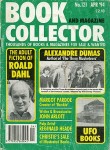
Article Text
Introduction:
TALES OF THE UNEXPECTED
Roald Dahl once boasted, with a typical lack of modesty, that his name was known to virtually every child in the western world, but he might also have added that he was a familiar figure to quite a few adults as well.
In recent years, Dahl’s immense success as a children’s author has tended to eclipse his earlier career as a short-story writer. Between 1946 and 1974, he published four collections of adult tales that won him a huge readership on both sides of the Atlantic. He was particularly popular in America, where he received over $2,000 a story!
He was less successful as a novelist, his first long work of fiction, Sometime Never, disappearing without trace when it was published in 1949, and his second, My Uncle Oswald (1979), faring little better. Nevertheless, it is these adult works that now attract the highest prices from collectors, with his earliest titles fetching three-figure sums in their dustjackets. Our main feature this month looks at this aspect of Dahl’s work.
THE ADULT FICTION OF ROALD DAHL
Roald Dahl was not only the bestselling children’s author of his time, he was also one of the most accomplished writers of adult short stories. His macabre contes cruel have been reprinted many times, and were successfully televised in 1979-80 as “Tales of the Unexpected“. They are among the most memorable written by a British author over the past half-century.
Noel Coward hit the nail on the head when he wrote in his diary, after reading Dahl’s second collection, Someone Like You, forty years ago: “The stories are brilliant and his imagination is fabulous. Unfortunately there is, in all of them, an underlying streak of cruelty and macabre unpleasantness, and a curiously adolescent emphasis on sex.”
The strange and complex personality who created these quirky tales of love and revenge has been expertly unravelled in a fascinating new biography by Jeremy Treglown, published on 21st March by Faber & Faber.
Roald Dahl was born to Norwegian parents in Llandaff, south Wales, on 13th September 1916. He lost both his elder sister (from appendicitis) and father (pneumonia) when he was only three. His mother, Sofie (to whom he dedicated his memoir, Going Solo), “was undoubtedly the absolute primary influence on my own life. She had a crystal-clear intellect and a deep interest in almost everything under the sun.”
FORMATIVE
He was sent to St. Peter’s Prep School — “the greatest torture in the world” — in Weston-super-Mare, where he acquired a copy of the newly-published Can Such Things Be (Cape: ‘Traveller’s Library’, 1926). This classic collection of stories by Ambrose Bierce “profoundly fascinated and probably influenced” the young Dahl, and almost certainly sowed the seeds of his own successful career as a short-story writer. At the age of ten, he could never have guessed that the company which issued that formative book would become the main publisher of his children’s books nearly half-a-century later.
His next school, Repton, was equally distasteful to him. In Boy: Tales of Childhood (Cape, 1984), and also in several TV interviews, Dahl represented the headmaster, Godfrey Fisher (who later became Archbishop of Canterbury and crowned Queen Elizabeth II), as a sadistic flogger, but Jeremy Treglown proves clearly that Fisher had, in fact left Repton a year before the beatings described in Boy.
The dreaded headmaster who succeeded Fisher and who made the lives of so many Repton pupils a misery was J. T. Christie who, according to the philosopher, Richard Wollheim, “rejoiced in beating boys” (he moved on to Westminster in 1937). If Dahl mixed up these two men, then how many of the other ‘facts’ in his two volumes of memoirs can be trusted? Much is clarified in Treglown’s book.
After leaving Repton in 1934, Dahl joined the Shell Oil Company, and spent an exciting few years in Tanganyika. At the outbreak of war, he signed up with the Royal Air Force, receiving his training in Kenya and Iraq before being posted to the Number 80 Fighter Squadron based in the western deserts of Libya.
In Going Solo, Dahl describes many heroic exploits, from being “shot down and crippled in an air-battle” to inventing the RAF expression, ‘gremlins’. Treglown shows that Dahl was not shot down as he often claimed: in fact he ran out of petrol and was forced to crash land. He also reveals that he was officially a flight lieutenant, and not a ‘wing commander’ as he claimed in Who’s Who.
WASHINGTON
Dahl was invalided back to England in 1941, and was promoted to the post of Assistant Air Attaché at the British Embassy in Washington the following year. During his first week in this job, he was contacted by C. S. Forester who was writing an article on fighter pilots for the Saturday Evening Post and wanted to hear something of his experiences in North Africa. Dahl sent him an account of his short career in the service, and two weeks later Forester wrote back: “You were meant to give me notes, not a finished story. I’m bowled over. Your piece is marvellous. It is the work of a gifted writer… Did you know you were a writer?”
Dahl was paid $900 for the article, which appeared (anonymously) in the August 1942 issue of the Post under the title, ‘Shot Down in Libya’. The story was introduced as a “factual report on Libyan air fighting” by an unnamed RAF pilot “at present in this country for medical reasons” (a reference to his back injury).
Dahl’ s first book for children, The Gremlins, was originally serialised in Cosmopolitan magazine in 1942, and he contributed several more flying stories to the Saturday Evening Post, Atlantic Monthly (‘The Sword’, July 1943) and Ladies Home Journal (‘Katina’, March 1944).
EXPLOITS
Over to You: Ten Stories of Flyers and Flying, was first published in the United States by the short-lived company, Reynal & Hitchcock, in 1946, and soon afterwards in Britain by Hamish Hamilton.
Mersa Matruh, Cairo, Spitfires over the Channel and the heroic exploits of RAF fighters in the first Greek campaign, all feature in these vivid stories. Everyone of them is concerned with the war in the air and its psychological effect on the men who fought it. The author recaptures the spirit of “those early days when we were fighting in Libya; one flew very hard in those days because there were not many pilots; they certainly could not send any out from England, because they were fighting the Battle of Britain”.
The stories in Over to You were favourably compared with those of ‘Flying Officer X’ (H. E. Bates) and ‘Gunbuster’ (John Charles Austin). Noel Coward noted in his diary that they “pierced the layers of my consciousness and stirred up the very deep feelings I had during the war and have since, almost deliberately, been in danger of losing”.
The American first edition now fetches £150-£200 (Very Good with jacket), compared with £100-£150 for the U.K. equivalent. The dustjacket of the latter features a distinctive Roger Furse design, showing two white wings.
Dahl’s first four adult books — published between 1946 and 1960 — are eminently collectable in pristine condition. However, all are notoriously difficult to find with Very Good/Fine dustjackets. Whenever they turn up in catalogues, the descriptions of the jackets usually run from “internally repaired” and “lacks small piece at head of spine”, to “worn and chipped with some loss”. These faults can sometimes mean a difference in price of £30-£60, or more! The dustjacket of my own copy of Over to You is predictably worn at the edges, but has not had the ‘7/6’ price tag removed.
Dahl’s first novel (and least-known book), Sometime Never: A Fable for Supermen, was written at high speed during the summer of 1946, and first published by Scribner in the U.S. in 1948, and by Collins in Britain the following year.
In essence, this weird, futuristic fantasy — one of the very earliest novels about nuclear war — blends elements of Dahl’s first children’s book, The Gremlins (1943), with Tolkien, Lewis Carroll and Orwell. The story opens during the Battle of Britain, and concludes with the end of civilisation. The second part of the novel presents a world dominated by communism, whose apologists are described by Dahl as “too brainless even to amass coin-collections for themselves, [but] preach… that all coins should be shared by all people”.
After the Third World War (and before the all-destroying Fourth), an underground kingdom is whimsically ruled over by the leader of the Gremlins, who alternately bullies his subjects and appeases them with sweet fruits called snozzberries. Their misogyny (“the female of any type is always more scheming, cunning, jealous and relentless than the male”) anticipates that of many of Dahl’s later stories.
Overall the novel reads like a hastily written first draft, and is in dire need of editing. It was a complete flop on both sides of the Atlantic, and neither Scribner nor Collins showed any further interest in Dahl’ s stories. The book has subsequently remained out of print everywhere — apart from Holland, where it was reissued in 1982.
DUST JACKETS
Very Good copies of the Scribner edition fetch an average of £120-£150 in dustjackets (although I have seen examples advertised at anything from £35 with a very worn jacket to $300 with one described as “rubbed”), compared to £80-£120 for the Collins equivalent.
Dahl was by now earning large sums from selling articles and short stories to American magazines. Colliers paid him $2,250 for ‘Man from the South’, a sinister tale (which Dahl subsequently sold to the BBC) about a very gruesome bet, and he received similar sums from the same magazine for other stories, including ‘Poison’, a classic tale about an imaginary snake.
His first sales to the prestigious New Yorker were ‘The Sound Machine’ (May 1949), a fantasy about a man who believes he can hear noises made by plants; and a story about a fraudulent wine connoisseur, ‘Taste’ (August 1951). An article on ‘Love’ for the Ladies Home Journal earned him $2,500, and was followed by a piece on the Mildenhall treasure (‘He Plowed Up $1,000,000’).
In March 1952, the sixty-year-old publisher, Alfred Knopf (a noted wine expert), read ‘Taste’ in a back-number of the New Yorker, thought it “stunning”, and promptly secured the rights to Dahl’s next collection of stories.
Someone Like You, which contains such classics as ‘Taste’, ‘Lamb to the Slaughter’, ‘Man from the South’, ‘The Soldier’, ‘Neck’, ‘The Sound Machine’ and ‘Nunc Dimittis’, was first published in the United States by Knopf in the autumn of 1953. Dahl’s recent marriage (in July) to the well-known actress, Patricia Neal, brought the book considerable publicity, and certainly raised sales.
Most of the American reviewers were ecstatic about the collection. The New York Times wrote: ” At disconcertingly long intervals, the compleat short-story writer comes along who knows how to blend and season four notable talents: an antic imagination, an eye for the anecdotal predicament with a twist at the end, a savage sense of humor suitable for stabbing or cutting, and an economical precise writing style. No worshipper of Chekhov, he. You’ll find him marching with solid plotters like Saki and O. Henry, Maupassant and Maugham… The reader looking for sweetness, light, and subtle characterization will have to try another address. Tension is his business; give him a surprise denouement, and he’ll give you a story leading up to it. His name in this instance is Roald Dahl.”
HUMOUR
Dahl’s black humour was often compared to that of the New Yorker cartoonist, Charles Addams (see BMC 103), and his twist-in-the-tale plots with those of expatriate English writer, John Collier.
By Christmas 1953, 7,500 copies of Someone Like You had been sold (which Knopf told Dahl was a record for short stories), and the book reached its fourth printing by February 1954. In April of that year, it won the Mystery Writers of America ‘Edgar’ award.
The collection was less successful in Britain. Priced at 12/6, the first edition had poor sales, and copies are now very hard to find in really good condition. These now fetch up to £75 in the dustjacket, compared with £80-£120 for the Knopf edition. Two of his best-known stories were written at this time, following a temporary rift with Patricia Neal. Both are about tyrannical husbands. ‘The Way Up to Heaven’ (New Yorker, January 1954) features a woman with a pathological fear of unpunctuality, who leaves her spouse to die in a lift after discovering that his constant delays are deliberate. The ‘hero’ of ‘William and Mary’ suffers an even more gruesome fate: following his death, his still-conscious brain (with one eye attached) is taken home in a dish by his embittered wife! Although Dahl wrote the latter tale soon after Curt Siodmak’s strikingly similar novel Donovan’s Brain (published by Knopf in 1943), had been filmed with Lew Ayres and Nancy (Reagan) Davis in the leading roles, he claimed not to have seen — or even heard about — the movie until he’d finished his own story.
Either way, the New Yorker rejected ‘William and Mary’ when it was sent to them in 1954, and again three years later. Between February 1957 and March 1959, six other stories suffered the same fate, including the repulsive ‘Pig’, in which an orphan brought up as a vegetarian is slaughtered in an abattoir; ‘Genesis and Catastrophe’, an ironical account of the birth of Hitler; and ‘Royal Jelly’, an excess of which causes a baby to turn into a bee!
These stories, along with a number of others written between 1953 and 1959 — eleven in all — make up Dahl’ s third collection, Kiss Kiss, published by Knopf in early February 1960, with a massive advertising campaign linking it to St. Valentine’s Day! The print-run of the first edition was much larger than that for Someone Like You — 24,000 copies, of which two-thirds had been sold by April.
ENTERPRISING
In March 1960, the Dahls and their children, Olivia and Tessa, sailed from New York to England on the ‘Queen Elizabeth’. By a fortunate coincidence, Dahl’s agent, his first ‘patron’, C. S. Forester, and an enterprising British publisher, Charles Pick (recently appointed managing director of Michael Joseph), were also on board.
Pick had purchased a copy of Kiss Kiss to read on the voyage, and was very impressed by it. By the time the ship docked at Southampton, he had bought the U.K. rights to the book, in return for a generous royalty of (to begin with) 12.5%. So began Dahl’s longest-running partnership with any British publishing company (although Pick was to remain with the firm for only two more years). As is evident from his bibliography, his earlier dealings with London publishers had been decidedly shortlived, mainly due to his dissatisfaction with the lack of promotion of his works, to which he attributed their poor sales.
Charles Pick was a great publicist, and immediately persuaded the literary editor of the Sunday Times to print ‘The Way Up to Heaven’ in the newspaper as ‘holiday reading’. Published by Michael Joseph in October 1960, Kiss Kiss turned out to be a much greater popular and critical success in the U.K. than Someone Like You, achieving hardback sales of 20,000 copies within two years.
OMNIBUS
Michael Joseph promptly brought the rights to the now out-of-print Someone Like You, reissuing this collection — along with two extra stories — in 1961. Both these books featured superb Charles E. Skaggs dustjackets. The stories from these two volumes were later amalgamated in an omnibus edition entitled Twenty Nine Kisses from Roald Dahl, which was published by Michael Joseph in 1969.
In the late Fifties, Dahl found it increasingly difficult to think up new stories, and he had no ideas for a new novel (which Knopf continually demanded). He was both amazed and delighted at the way that his relatively small body of work continued to earn him large amounts of money, especially from Europe (at least five million copies of his adult books have been sold in German-language editions alone).
But his literary talents were now taking a new direction, beginning in 1961 with the publication in the United States of his first major children’s book, James and the Giant Peach, which was based on a story he’d originally told his two daughters, Olivia and Tessa. The first draft of another story, ‘Charlie’s Chocolate Boy’, was completed in 1960, after the family had settled in England at Gipsy House in Great Missenden — Dahl’s home for the last thirty years of his life.
The Dahl family was hit by a series of tragedies in the early 1960s: first, four-month-old Theo was seriously injured when his pram was struck by a cab in New York in 1960; then, the delicate Olivia almost succumbed to a virulent attack of measles in 1962; and finally, in 1965, Dahl’s wife, Patricia Neal, suffered two successive strokes whilst in Hollywood.
With Charles Pick no longer managing the company, Michael Joseph showed no interest in either James and the Giant Peach or Charlie and the Chocolate Factory (the final version of ‘Charlie’s Chocolate Boy’). Other London firms were similarily unimpressed, considering both books to be really “adult stories in disguise”. They were eventually published in this country by G. Allen & Unwin in 1967.
In 1967-8, Dahl turned his attention to screen-writing, adapting two very different works by lan Fleming — the ‘James Bond’ novel, You Only Live Twice, and his juvenile fantasy, Chitty Chitty Bang Bang — for the cinema. He also began a screenplay of Aldous Huxley’s Brave New World, but never completed it.
He then bought the screen rights to a novel by Joy Cowley called Nest in a Falling Tree, which he adapted as The Night Digger. The film starred Patricia Neal as Maura, a woman recovering from a cerebral aneurysm who works part-time in a Buckinghamshire children’ s hospital. The film sank without trace in America, and has never been released in Britain.
EROTIC
Beginning with ‘The Last Act’, Dahl then wrote some violently erotic stories, all of which were published in Playboy (they were too spicy for the New Yorker!). Most of these take a dark, rather Gothic view of sex: in ‘The Visitor’, for instance, Uncle Oswald, discovers that he may have slept with a leper, while ‘Bitch’ ends with him being assaulted by a hideous woman to whom he has administered a powerful aphrodisiac. These three stories — along with one other, ‘The Great Switcheroo’, in which two men devise a plan for going to bed with each others wives without the women realising — make up Dahl’s fourth collection, Switch Bitch, published in both Britain (Michael Joseph) and America (Knopf) in 1974.
Discussing these stories in a recent article in the Times Literary Supplement, Frederic Raphael wrote: “There was a kind of camp in Dahl’s later outrageousness… No one else could have written ‘Bitch’ — in which the hero is finally transformed into a walking, working phallus — without falling into tweeness or rising into pornography. The requirements of the marketplace served Dahl well; energy, rage, fancy, which might have taken monstrous wing — or been grounded entirely — were re-invested in toothsome ghoulishness.”
One of Dahl’s later tales, ‘The Bookseller’ (Playboy, January 1987), is about a sleazy bookdealer who blackmails the families of recently-deceased men by sending them a spurious bill for the purchase of hardcore pornographic books. His downfall comes when he chooses a blind man as a victim. (Evelyn Laye gave a memorable performance as the man’s widow when the story was televised in 1988.)
The publication of My Uncle Oswald in 1979 — exactly thirty years after his only other attempt at along work of fiction, Sometime Never — finally proved to the world that Dahl was incapable of writing a successful novel for adults.
As Jeremy Treglown comments in his new book, Dahl was really scraping the barrel with this work, which describes Uncle Oswald’s attempts to procure semen-samples from some of the world’s great men in order to sell them to wealthy, childless women. Because of Dahl’ s notoriously unreliable memory , the text had to be carefully edited by the publishers. Balzac was among the original roster of donors, despite the fact that the book is set in 1919! (Strangely, Dumas was omitted!) Typically, Dahl’s schoolboy humour was much in evidence, most notably when he makes a joke about the size of Stravinsky’s penis. “Madame S is still alive (and wonderful),” commented Robert Gottlieb, Dahl’s hard-pressed editor at Knopf, “and I feel she would be distressed.”
In short, My Uncle Oswald is a complete disaster — an author like Tom Sharpe would have made a far wittier novel out of the same material. It was universally panned by the critics, and Dahl later regretted that it had ever been published.
Gottlieb put up with Dahl’s frequent tantrums and increasingly rude letters until 1981. As a publisher, he had always operated on what he calls the ‘F*** You’ Principle, under which he was willing to accept “almost any amount of shit from any given writer” on the unspoken proviso that, when he could take no more, he would be free “to turn around and say ‘F*** you'”.
PARTNERSHIP
And that was precisely what he now did with Dahl in a letter which is printed in full in the new biography. (According to Gottlieb, when his letter went off, everyone at Knopf who had ever had any dealings with the author “stood on their desks and cheered”!) So ended the 38-year-old partnership between Dahl and Knopf, a company which had done so much to champion his career when he was still relatively unknown in Britain.
In 1979, Dahl’s stories were successfully transferred to the screen in Anglia Television’s hit series, Tales of the Unexpected. This was hosted by Dahl himself — looking suitably creepy seated in his armchair next to a roaring fire — and featured a number of big-name actors, including José Ferrer (‘Man from the South’), Joseph Cotten, Sir John Gielgud and Joan Collins (who co-starred in the hilarious ‘Neck’). The series spawned two spin-off collections: Tales of the Unexpected (Michael Joseph, 1979; actually published one month after the Penguin edition) and More Tales of the Unexpected (Michael Joseph, 1980; with four new stories).
After the supply of Dahl’s own stories had been exhausted, the series limped on for another two years with adaptations of work by other, less distinguished authors. (Incidentally, this series should not be confused with an earlier, American one from 1977, also entitled Tales of the Unexpected, which was hosted by the late, great William Conrad — nothing to do with Roald Dahl at all!)
In 1983, Jonathan Cape published Roald Dahl’s Book of Ghost Stories, the dustjacket of which features a large photograph of the author. However, his work is conspicuous by its absence from the book itself — as he freely admitted: “Good ghost stories, like good children’s books, are damnably difficult to write — I have always longed to write just one decent ghost story, [but] I have never succeeded in bringing it off.”
In 1958, he had been commissioned by film producer, Edwin Knopf (his publisher’s half-brother), to select 24 supernatural stories for a TV series entitled Ghost Time. This was never made, but Dahl’s shortlist was the basis for his 1983 anthology.
In 1983, Roald Dahl and Patricia Neal were divorced after thirty years of marriage, and later that same year he married Felicity Crosland. Despite the fact that they were of, respectively, Norwegian and Portugese parentage (her maiden name was ‘d’Abreau’), both had coincidentally been born in the Welsh town of Llandaff. They collaborated on a coffee-table-style cookery book, Memories with Food at Gipsy House (1991), which includes a family tree from which both their former spouses are omitted!
COMEBACK
In 1986, Dahl tried to make a comeback as an adult writer with Two Fables, a slim, 64-page hardback published to celebrate his seventieth birthday. This contained two mildly pornographic fairy-tales: ‘Princess Mammalia’ and ‘The Princess and the Poacher’. Graham Dean provided the cover illustrations, and the dustjacket was designed by Bet Ayer. Viking also issued an Edition-De-Luxe, limited to 300 copies signed by DahL and bound in quarter red leather.
Both these ‘fables’ were discretely omitted from Dahl’s Collected Short Stories, a 762-page omnibus edition published by Michael Joseph in 1991. Ah, Sweet Mystery of Life (1989; illustrated by John Lawrence) is a collection of country stories which Dahl had once hoped to merge into a complete novel (yet another unrealised project). Apart from the title-piece, this volume includes four stories (about ratcatching, maggot-farming and other rustic delights) from Someone Like You and two — ‘Parson’s Pleasure’ and ‘The Champion of the World’ — from Kiss Kiss.
Unfortunately, Dahl did not mellow with age (he was desperately disappointed that he was never offered a knighthood), and he became well known for creating ‘scenes’ in public, and especially for his racist and misogynous comments.
According to Jeremy Treglown, book fairs made him particularly irritable, not least because “they make a writer aware of other writers, and how highly some of them are regarded. If illness and pain were principal causes of Dahl’s cantankerousness, envy was another. Going Solo had been an inspired title for the second volume of his autobiography; he could never be a mere member of a group.”
The difficulties he had experienced getting his books published in Britain in the Forties and Fifties gave him a lasting grudge against the London ‘literary establishment’, whom he believed were out of touch with the general public. He was genuinely convinced that he voiced the opinions of the ‘silent majority’ when he spoke out against such subjects as the Booker Prize and Salman Rushdie.
In a letter to the Times (28th February 1989), Dahl claimed that Rushdie had prompted his own downfall by deliberately courting notoriety in an attempt to boost sales of his books (had he never done the same himself?) and that same year he maintained, in a widely publicised speech, that the Booker Prize judges tended to choose ‘beautifully-crafted’ novels that were also “often beautifully boring”! (“Balls!” shouted Laurie Lee from the audience.) He always derived a great deal of satisfaction from being utterly opposed to the majority of his fellow writers.
POPULARITY
On the other hand, Dahl defended the books of Enid Blyton, pointing out that — whatever adults felt about them — they remained popular with millions of children. Of course, as she’d been dead for almost twenty years, she was no longer a threat to him, although she is still his only rival in terms of popularity and sales.
Dahl was also something of a philanthropist, actively supporting the Dyslexia Institute and other organisations concerned with learning difficulties. He paid for equipment for disabled children and funded research programmes into neurological disorders, and was a generous donor to a number of medical appeals, including that for the Great Ormond Street Hospital.
Half of his royalties now go to fund the Roald Dahl Foundation, which makes grants to projects in areas with which he was personally concerned, notably neurology, haematology and literacy. In 1992, the Foundation helped to build a library for an epileptics’ centre in Cheshire and provided a minibus for a school for epileptic children. It will continue to offer support to other good causes until the copyright on Dahl’s works expires in 2060.
Roald Dahl died on 23rd November 1990, and was buried on the hillside opposite Gipsy House. His family subsequently placed a notice in the Times describing him as a “scrumiddly-umptious husband and a wondercrump father”. Ophelia Dahl is now working on the ‘official’ biography of her father.
Jeremy Treglown’s biography is unauthorised and is all the more powerful for that. It is a compulsive read, and presents a well-rounded portrait of this unique writer who, for all his faults, was undoubtedly generous and charismatic. This book is essential reading for the millions who have enjoyed his funny, scary, sometimes scatalogical but always immaculately-crafted stories.